We arrived knowing that the City had a free park for RVers. What we didn’t know was that it had electric hookups, even 50 amp. It was a delightful evening and just as we were eating dinner several pickups pulled into the park near the bandstand. They started unloading chairs, instruments, etc. At 7:30 the concert began. We enjoyed it very much even though the bugs about carried us off. Following the concert we decided it was time for a walk around town. We couldn’t have been more delighted.
In this one you can see our motorhome in the background. 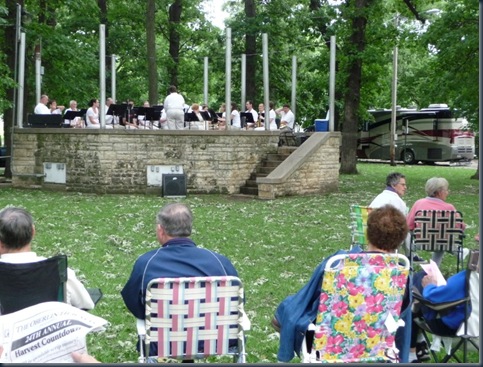
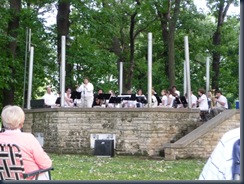
There was much to see, in the park itself there are black squirrels to entertain you. The tale is told that a circus came to town with black squirrels. During the night some children opened the cages and let them escape. It is now known as the city’s mascot and protected by a City Ordinance.


Also in the park is a sod house, a little red schoolhouse, a steam locomotive and a train depot that had been the Beattie Depot. It still bears the name Beattie. We learned from the curator at the Pony Express Museum that a gentleman attending the sale of the Depot kept watching, no one seemed to be bidding so he bid $2. Sold was the cry and he obtained the Depot. He donated it to the city of Marysville who then had the job of moving it into the park. It is our understanding that the gentleman who purchased it got lots of credit but his only outlay was $2.
The sod house was very interesting. In our travels we had seen lots of adobe brick houses which look much like the sod house except for one difference. You can still see the dead grass in the sod house construction. The sod house was created by the Marysville Kiwanis Club to depict life in its earliest days in this community.
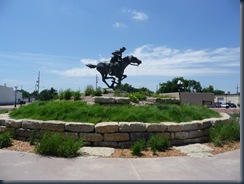
The downtown area is quite interesting. The first thing we saw there was the Pony Express Statue. I’ve included 2 pictures of it to give you a better understanding of its location. Around the perimeter of the area are some newly acquired pictures. They are made up of tiles. One shows the steam locomotive and the newer locomotive. The other shows the pony express riders. As you progress along the walkway in front of them the pictures change. I tried to get some pictures but they just really don’t do justice to what is happening. Then I tried to do a movie but that didn’t work at all.

As we walked up the street we saw this building. The design was so unique I had to share it with you.

Across the street from it was the building which housed the very 1st Montgomery Ward Store in the US.


We weren’t aware of it until we visited the Pony Express Museum(below) and saw this photo(above) with this information sign(right).
 The Pony Express Barn is the only original station still standing. It was booked as Home Station #1 meaning that it was the first station outside St. Joseph where they changed riders. The stations between Marysville and St. Joe were for changes of horses only.
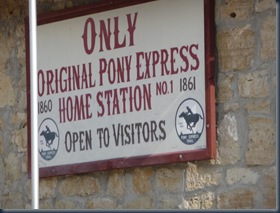 If you have been reading you will note that Seneca also billed themselves as the 1st Home Station. We don’t know why this has happened but we really didn’t realize it until we started writing it up. We kind of believe that it was Seneca. After checking the internet and carefully counting the stations on their route we found the Seneca was the 10th stations on the route. Reports were that each were 10 miles apart and they rode about 100 miles before switching riders. But the facts are only as accurate as the reporter and there are a variety of reporters around.
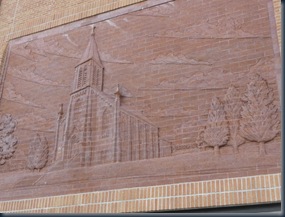
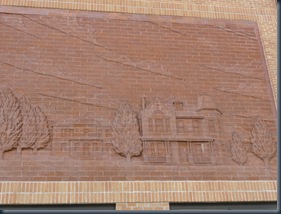
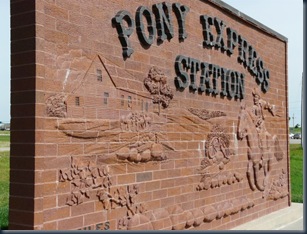
There is much of the bas relief in the area. These two pictures were on the side of a large church on Hwy 36. Later we will show you another. We had seen some of this in other parts of the country, a really big one on a bank in Valentine, NE depicts the longhorn heard being driven to market,and another one in Creston, IA(I don’t remember what that picture was). They are made of brick. It might be like the chicken and the egg, we don’t know which comes first. Whether they make the brick with the pattern molded into it or if it is a brick wall, extra thick, that they grind into the pattern. If anyone knows we would love to hear about it.
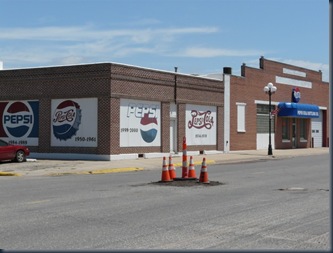
We spent lots of time walking the streets of Marysville, not only for exercise but also because it is just a generally lovely town. One of the things we happened on was the Pepsi Bottling Plant. They had these logos with the dates they had been used by the company. I guess they all looked familiar and we don’t think about the changes until we see them in this format. In case you can’t read them, they are from left to right (1984-1989) (1950-1961) (1998-2000)and (1934-1939).
The entire block where the Koester home is has been set aside as a historic site. The lions guard the entrance to the Koester House Museum. Finished in 1876, it was the home of the prominent Koester family. It is furnished with turn-of-the-century items and is open for tours from April thru October (year round by appointment). Surrounded by a brick wall and with cast iron lions and dogs guarding its gates, the grounds of the house are nearly as interesting as the interior. A summer kitchen, ice house, carriage

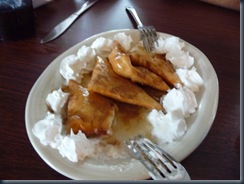
house and 12 white bronze statues make a stroll through the yard an experience to remember. The town had a pretty bad hail storm recently, many windows were broken in the house and the day we wanted to go through the house it was closed. Another smaller house was later built in a similar style for the Koester’s son. That house has been converted to a Mexican Restaurant and we enjoyed a great lunch there. We even ordered sopapillas for dessert and when they came they looked so pretty I thought you might like to see. I’d never seen them served with cinnamon and honey over them and whipped cream all around. YUM!
Another building in town that we found really interesting was the Old Courthouse, built in 1891. It is a brick faced Romanesque gem with columns of polished red granite. “Justice” stands out in terra-cotta in cornices above the second floor windows. The roof is slate and galvanized iron; tower is capped with copper. Wainscoting in the main corridors and stairs is enameled brick; the lobby and corridors are tiled. Treads on the iron stairway are slate. The big wigs of the city wanted a new courthouse and wanted to tear this one down. As you can see that would have been criminal. It is a beautiful structure and we are so glad the people of the town protested and allowed it to remain. It is now a research facility and museum thanks to the County Historical Society who purchased the building for $1 and saved it. Some of the things I thought most interesting in the museum were the kerosene kitchen stove.
This enabled the women to cook in summer and keep their homes a little cooler than using wood. Another display I was interested in was the quilt.
 If you click on it you will get a larger picture and be able to see the enormous amount of work that went into it. Beside the quilt was a small table. Gary wanted me to guess what it was for.
 I couldn’t, it is for stretching doilies. It had small holes at each intersection. You can’t see the circles very well but they are there too. I assume you stretched it and put little pegs of some kind into the holes to hold it in shape.
Something else in the courthouse that I found interesting was the chairs in the courtroom. They each had a hat rack under them.
 You can see a hat in one and if you notice the 2nd one over from it is tipped up and if you click on it to enlarge it you will see the rack under it. For a very long time no women were allowed to serve on the jury’s, the reason was that there was no women’s restroom in the jury room, only a men’s. Later another restroom was added and women were allowed to serve.
Another day we decided to go visit the Alcove Spring and just do some driving around the country. Imagine it is 1843 and you and your family loaded with clothing, food, utensils and a few keepsakes into a covered wagon and left Independence, MO in late April for a 2,200 mile trip along the Oregon Trail. You arrive at the Big Blue River. The river is swollen after recent rains, and it’s time to camp for a few days. Near your campsite is a small tributary, which you follow for about ¾ mile and discover one of the most beautiful and serene sites along the Oregon Trail – Alcove Spring. The spring, according to history reports has never gone dry, even during the years of the dust bowl drought.
(Sorry we didn’t get a picture there.)
From there we continued south and viewed the Gypsum Plant. Gypsum is mined here. Bestwall Gypsum Co financed a new plant and equipment. Cost was nearly $4 million. The firm mines gypsum and manufactures wallboard used in construction of homes and office buildings over the nation. Local financial assistance enabled Richard and Clark Manufacturing Company to start production in October 1965.

Continuing on our journey we were starting to get hungry. The first town we came to was Waterville. We drove through town, seeing the newly remodeled Hotel and the Opry house but didn’t see any restaurants.
The next town was Barnes and it didn’t look like there was much hope. The City Café had a closed sign on the front so we continued down the street and luckily found “Our Daily Bread”, a bakery & bistro is how it was booked on the sign. We decided it worth a try and were pleasantly surprised to find a great restaurant. We have taken pictures of the menu’s to give you an idea of the character of the restaurant. Gary chose the beef stroganoff, I had the chicken divan. Dinner without pie was $7.45 – with pie was $8.95


Gary had Coconut Cream pie (which had 3” meringue)(his favorite) I had mixed berry and it was great too.

The ceiling in the restaurant is a lovely old tin one. It needs some brushing and painting but it definitely has potential.
Coming out of the restaurant I discovered a little beauty shop two doors down. She didn’t have any customers at that moment so I decided to get a haircut. Gary did some more picture taking around town while I was in the chair.
After the haircut we finished our travel looping back to Hwy 36. At that point there is a Pony Express Monument just North of the highway.
Hollenberg Ranch and Pony Express Historic Sign. 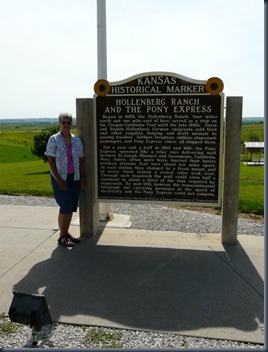
The sign reads: Begun in 1858, the Hollenberg Ranch, four miles north and one mile east of here, served as a stop on the Oregon-California Trail until the late 1860s. Gerat and Sophia Hollenberg, German emigrants, sold food and other supplies, lodging, and draft animals to passing travelers. Settlers, freighters, soldiers, stagecoach passengers, and Pony Express riders all stopped there.
For a year and a half in 1860 and 1861, the Pony Express operated like a relay race delivering mail between St.Joseph, Missouri, and Sacramento, CA. Wiry riders, often mere boys, hurried their horses between stations that were about ten miles apart. At each station they changed to a fresh mount, and at every third station a rested rider took over. Through such teamwork the mail could cross half a continent in about a third of the time required by stagecoach. By mid-1861, however, the transcontinental telegraph was carrying messages at the speed of electricity, and the Pony Express could not compete. In addition there is another brick bas relief sign depicting the pony express and the station. (Another discrepancy in the story.)This is the only place that said they rode this distance.
At the actual location of the Hollenberg Ranch a visitors center has been set up along with a reproduction of the Hollenberg Ranch building which held their home as well as their business. They have also maintained a garden but were not sure of the original location of the Hollenberg garden.

The Historic Trails Park had two markers and a replica of the Rope Ferry. It is located not far from the site of an early river crossing and the replica is full sized. Eight trails converged to cross the river at this point, using the Frank Marshall Ferry to cross. The rope ferry is a replica of the craft used by pioneers, Pony Express riders, and other trails travelers. A rope crossed the river above the ferry, which rode a pulley back and forth. By turning the wheel, another rope would shift the ferry into or away from the swift river current, pushing the ferry across the river.


The sign here at the city park says you can stay 5 days. We stayed our limit and are ready to move on. It has rained almost every night during our stay. We have been fortunate to have, for the most part, beautiful sunny days. Thanks for your patience, hopefully we will be able to keep up from now on, thanks to people on one of the forums we have found Windows Live Writer and it seems to be working better.
HAPPY TRAILS TO YOU ALL!


